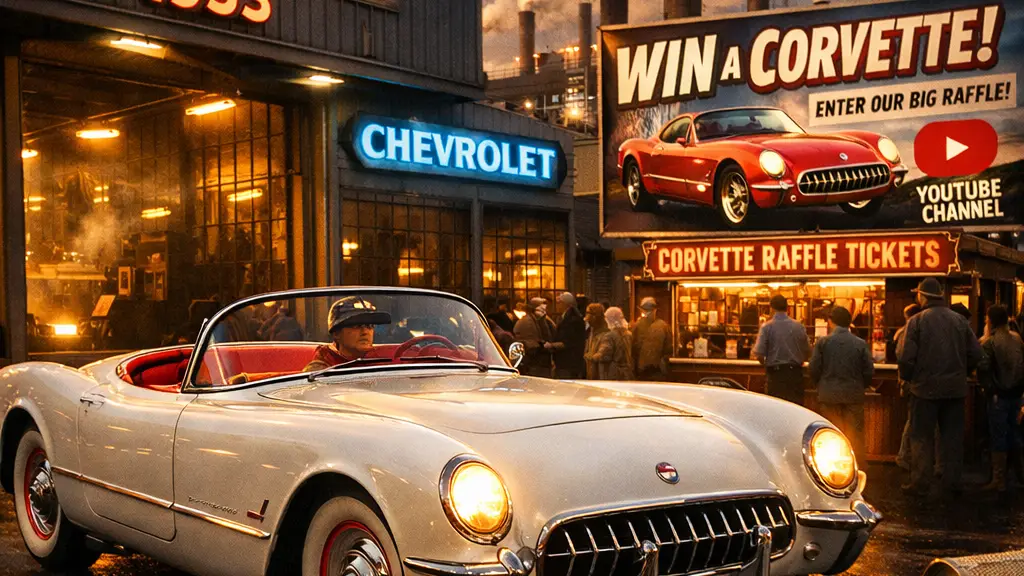
The Chevrolet Corvette rolled out of Flint, Michigan in 1953 and has never stopped—eight generations, no domestic rivals left standing. It nearly didn't happen. Fiberglass over a 3.9-liter straight-six, two-speed automatic, Chevrolet's answer to the lean British roadsters of the postwar years—it debuted at GM's Motorama in the Waldorf-Astoria and promptly sold almost none of its 300 hand-assembled units. A quiet beginning for what would become America's sports car.
Given that context, "be more conflicted" is a fascinating editorial note, because it implies the author wants to inject a narrator's ambivalence into what is otherwise a purely technical description. The surrounding context section header that riffs on a Jay-Z lyric ("I Got 5 on It")—suggests a voice that is personal, culturally aware, and probably not writing a dry enthusiast magazine piece. There is someone here who has feelings about this car.
The fifth-generation Corvette arrives in 1997, and it is, depending on who you ask, either the car that finally got it right or the car that proved it never needed to be right in the first place. It is a completely new animal underneath, even if you might not know it to look at it. The new LS1 still displaces 5.7 liters, still makes the number of horses that impresses people at the number—345—and still routes that power through either a four-speed automatic or a six-speed manual. The transmission moves to the rear of the car now, tucked against the differential. A better machine, probably. Whether that was ever really the point is another question.